
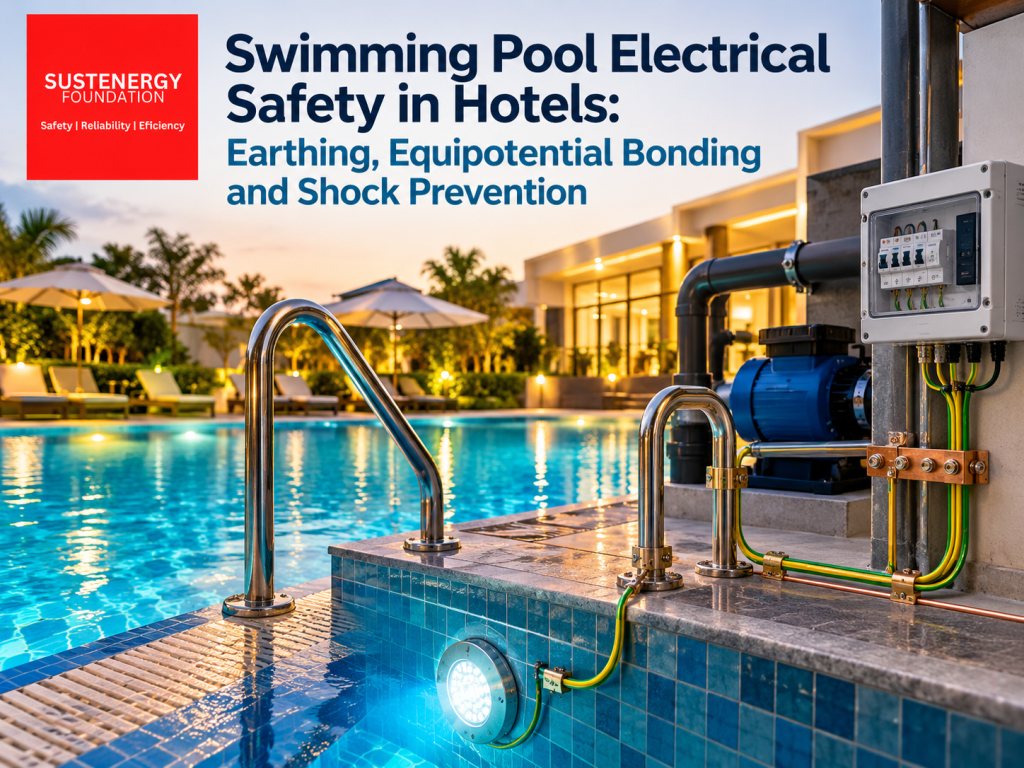
A swimming pool is often one of the most attractive features of a hotel or resort. Guests visit pools to relax, unwind and enjoy their stay. However, behind the clean water and comfortable surroundings, there is an important safety concern that hotel management must never overlook: electrical safety around swimming pools.
Water, wet floors, metal railings, underwater lights and electrical equipment can create hazardous conditions if the installation is not properly designed and maintained. An electrical fault involving a pool pump, lighting circuit or nearby equipment can expose guests and staff to electric shock, sometimes without any visible warning.
For hotels and resorts, swimming pool electrical safety is not just another maintenance responsibility. It is an essential part of protecting guests, employees and the property’s overall safety.
Proper earthing, equipotential bonding, residual current protection and periodic electrical safety inspections help reduce these risks and support a safer swimming environment.
1. Why Is Swimming Pool Electrical Safety So Important?
Swimming pools combine water and electricity in an environment where people are frequently barefoot, wet and in direct contact with conductive surfaces. Under these conditions, an electrical fault can have serious consequences.
Consider a situation where a pool pump develops an insulation fault or an underwater light becomes electrically unsafe. If the protective measures are inadequate, accessible metal components or surrounding surfaces may develop dangerous voltages.
A person touching an affected metal railing while standing on a surface at a different electrical potential could experience an electric shock. For someone in the water, the consequences can be particularly severe because an electric shock may cause muscle paralysis, loss of swimming ability, drowning or cardiac arrest.
This is why hotel swimming pool safety must extend beyond water quality, housekeeping and slip prevention.
Hotel owners, facility managers and maintenance teams should pay particular attention to:
- Electrical installations serving swimming pools and associated plant rooms.
- Pool pumps, filtration systems and electrical control panels.
- Underwater lighting and poolside electrical equipment.
- Metal ladders, handrails and other conductive components.
- Electrical sockets and equipment installed near wet areas.
- Earthing, equipotential bonding and residual current protection.
Identifying electrical hazards before they cause an incident is an important part of effective hotel electrical safety management.
2. Electrical Earthing: The First Line of Fault Protection
Electrical earthing plays a vital role in protecting people from electric shock. It provides an appropriate protective connection between exposed conductive parts of electrical equipment and the installation’s earthing system.
For example, if an insulation failure allows a live conductor to come into contact with the metal enclosure of a pool pump, the protective earthing arrangement helps establish a fault-current path. When correctly designed and coordinated with the protective devices, this helps disconnect the faulty circuit and reduce the risk of electric shock.
However, simply having an earth wire connected to a piece of equipment does not guarantee safety. The complete protective arrangement must be verified.
During a swimming pool electrical safety inspection, hotel engineering teams should ensure that:
- Pool pumps, filtration equipment and applicable control panels have correctly connected protective earthing conductors.
- Earthing terminals and connections are mechanically secure and protected against corrosion.
- Electrical panels, enclosures and cable entries are maintained in suitable condition for their environment.
- Protective conductors remain continuous after equipment replacement, repairs or renovation work.
- Appropriate electrical tests are performed to verify earthing continuity and fault-protection performance.
An important point for hotel maintenance teams: a satisfactory earth resistance reading alone does not confirm that an entire electrical installation is safe. The earthing arrangement, fault-loop characteristics and operation of the associated protective devices must also be evaluated.
Regular electrical testing helps identify weaknesses before they become serious safety hazards.
3. Equipotential Bonding: An Essential Swimming Pool Safety Measure
While earthing helps establish a protective path for fault current, equipotential bonding addresses another important risk: dangerous voltage differences between conductive parts.
Imagine a metal pool ladder and a nearby handrail developing different electrical potentials during a fault. If a person touches both simultaneously, an electric current could pass through the body.
Equipotential bonding helps reduce this risk by electrically connecting specified conductive parts so that potentially dangerous differences in voltage are limited.
Depending on the pool design and applicable electrical installation requirements, the bonding assessment may include:
- Metallic pool ladders and handrails.
- Accessible metallic pool fittings.
- Specified conductive pipework and structural metalwork.
- Other conductive parts identified by the applicable design and standards.
Not every metal object automatically requires bonding. The electrical design and applicable requirements must determine which parts need to be included in the bonding arrangement.
For hotels, this becomes particularly important when swimming pools undergo renovation or when new water features, metal fittings, lighting systems or associated equipment are installed.
Maintenance teams should verify that bonding connections are continuous, secure and protected against corrosion. Any alteration to the pool or its electrical installation should prompt a review of the existing bonding arrangement.
What Is the Difference Between Earthing and Equipotential Bonding?
Although these measures are closely related, they serve different purposes.
Earthing provides a protective connection that supports fault detection and automatic disconnection when correctly coordinated with the electrical protection system.
Equipotential bonding connects specified conductive parts to help reduce dangerous voltage differences between objects that a person could touch simultaneously.
Both measures are important components of swimming pool electrical safety. Neither should be treated as a substitute for the other.
4. RCD and RCCB Protection for Hotel Swimming Pools
Residual current protection is another important part of preventing electric shock around swimming pools.
Residual Current Devices (RCDs), including Residual Current Circuit Breakers (RCCBs) commonly used in Indian electrical installations, detect residual current and disconnect the supply when the applicable operating conditions are met.
When appropriately selected, installed and maintained, these devices can provide additional protection against certain electrical faults.
For hotel swimming pool installations, electrical engineers should verify that:
- Appropriate residual current protection is provided for the relevant circuits.
- The selected devices meet the applicable requirements for rated residual operating current and disconnection performance.
- Protective devices are compatible with the connected equipment and the overall circuit design.
- Functional testing is carried out in accordance with manufacturer instructions and the maintenance schedule.
- Defective or incorrectly rated protective devices are investigated and replaced by competent personnel.
It is important to understand that an RCCB does not replace protective earthing or equipotential bonding. It also does not eliminate every type of electrical hazard.
The effectiveness of the complete installation depends on the correct combination of earthing, bonding, insulation integrity, circuit protection and appropriate equipment selection.
5. Underwater Lighting, Pool Pumps and Electrical Equipment Safety
Swimming pool electrical equipment must be suitable for the conditions in which it operates. Water exposure, humidity, corrosion and the possibility of physical damage make equipment selection and installation particularly important.
Underwater lights, circulation pumps, filtration systems, control panels and poolside electrical accessories should be assessed against the applicable installation requirements.
Hotel engineering teams should pay particular attention to the following areas.
Underwater Swimming Pool Lights
Underwater lighting equipment must be specifically suitable for its intended application. The luminaire, power supply, cabling, connections and protective arrangements must comply with the applicable requirements for swimming pool installations.
Damaged light fittings, deteriorated seals, defective cable entries or unsuitable replacement components can compromise electrical safety.
Pool Pumps and Filtration Systems
Pool pumps often operate for extended periods and may be exposed to moisture, vibration and corrosive conditions.
Inspect pump enclosures, cable terminations, protective conductors and associated control panels for signs of damage or deterioration. Any abnormal electrical behaviour should be investigated promptly.
Poolside Sockets and Electrical Accessories
Sockets, switches and other electrical accessories near swimming pools require careful assessment because of their exposure to wet conditions and their proximity to people using the pool.
Their location, permitted use, protective measures and installation method must comply with the applicable requirements for the relevant swimming pool zones.
Equipment Suitable for Wet Environments
A product advertised as waterproof is not automatically suitable for installation in or around a swimming pool.
The equipment’s intended application, ingress protection rating, installation conditions and compliance with the relevant electrical requirements must all be considered.
Extra-low-voltage supplies may be required for particular applications. The permitted voltage, source arrangement and installation method should be determined from the applicable standard and equipment requirements rather than assumed.
6. Swimming Pool Electrical Safety Inspections in Hotels
Even a well-designed electrical installation can become unsafe if routine inspections and maintenance are neglected.
In hotels and resorts, pool equipment is exposed to continuous operation, humidity, cleaning chemicals, corrosion and occasional modifications. Over time, these conditions can affect connections, insulation and protective components.
A planned electrical safety inspection programme helps identify deterioration and verify that the installation continues to provide the intended level of protection.
A swimming pool electrical safety checklist for hotels should cover the following areas.
Earthing and bonding
- Verify protective conductor continuity and the condition of earthing connections.
- Inspect accessible bonding connections for looseness, corrosion or damage.
- Review bonding arrangements after changes to pool fittings, pipework or electrical equipment.
Electrical protection
- Verify the suitability and condition of circuit protection.
- Test RCDs or RCCBs according to manufacturer instructions and the established maintenance schedule.
- Investigate any signs of repeated tripping, overheating or abnormal electrical operation.
Equipment and wiring
- Inspect pool pumps, filtration systems, underwater lights and control panels.
- Check accessible cable entries, junction boxes and terminations for deterioration.
- Look for damaged insulation, moisture ingress, corrosion and unauthorised modifications.
Documentation and maintenance
- Maintain records of inspections, test results, defects and corrective actions.
- Ensure that repairs and modifications are performed by competent personnel.
- Review outstanding electrical safety issues and verify that corrective work has been completed.
The frequency and extent of testing should be determined by the applicable requirements, equipment manufacturers’ instructions, the installation’s condition and the hotel’s maintenance risk assessment.
A documented approach makes it easier for facility managers to track recurring issues and demonstrate that electrical safety is being managed systematically.
7. What Should Hotel Staff Do If Someone Reports an Electric Shock or Tingling Sensation?
Reports of tingling in swimming pool water or around poolside equipment must never be dismissed as minor complaints.
Such symptoms may indicate an electrical hazard requiring immediate investigation.
If a guest or employee reports tingling, an electric shock or unusual electrical sensations near the pool, hotel management should:
- Prevent further exposure: Stop people from entering the pool and keep guests away from the potentially affected area.
- Raise the alarm: Inform the responsible engineering team and activate the hotel’s emergency procedures.
- Arrange safe electrical isolation: Authorised personnel should isolate the suspected supply from a safe location using the appropriate procedure.
- Avoid entering the water: Never enter potentially energised pool water to attempt a rescue. Follow emergency response procedures and use trained responders.
- Obtain medical assistance: Anyone who may have experienced an electric shock should receive appropriate medical assessment. Call emergency services when necessary.
- Investigate before reopening: The pool must remain closed until the electrical hazard has been investigated, the necessary repairs have been completed and competent personnel have verified that it is safe to reopen.
Hotel staff should never assume that switching off a single piece of equipment has eliminated the hazard. The source of the fault must be identified and the safety of the relevant electrical installation verified.
Clear emergency procedures and staff awareness can make a critical difference when an electrical incident occurs.
8. Electrical Safety Standards and Compliance for Hotel Swimming Pools in India
Hotels in India should ensure that swimming pool electrical installations are designed, installed, inspected and maintained in accordance with the applicable statutory requirements and relevant technical standards.
The assessment should consider the electrical installation rules applicable to swimming pool locations, the equipment manufacturer’s instructions and the requirements relevant to the specific installation.
Depending on the project, relevant references may include applicable provisions of the National Electrical Code of India, IS 732 for electrical wiring installations, and the relevant parts of the IEC 60364 series addressing electrical installations in special locations, including swimming pools.
The applicable requirements should be confirmed against the current editions, amendments and project-specific obligations.
For hotel owners and facility managers, compliance should not be treated as a documentation exercise alone. The installation must be physically inspected and appropriately tested to verify that protective measures are effective.
A professional electrical safety audit can help identify unsafe conditions, gaps in maintenance practices and areas requiring corrective action.
Conclusion: Making Swimming Pool Electrical Safety a Hotel Priority
Swimming pools contribute to the guest experience, but they also require careful electrical safety management. Water, conductive surfaces and electrical equipment create risks that cannot be addressed through routine housekeeping or visual inspections alone.
Effective swimming pool electrical safety in hotels depends on properly designed earthing, appropriate equipotential bonding, suitable RCD or RCCB protection, correctly selected equipment and periodic electrical inspection and testing.
Hotel owners, facility managers and engineering teams should make these measures part of their regular safety and maintenance programmes. Electrical modifications, equipment replacement and pool renovations should also trigger appropriate safety reviews.
For hotels and resorts, a proactive approach to electrical safety helps protect guests and employees, supports reliable facility operations and demonstrates a genuine commitment to responsible hotel management.
Professional assessment and periodic verification can help identify hidden electrical hazards before they lead to serious incidents.
Looking to improve electrical safety in your hotel or resort? Visit Hotel Electrical Safety to learn more about electrical safety audits and practical approaches to managing electrical risks across hotel facilities.
