
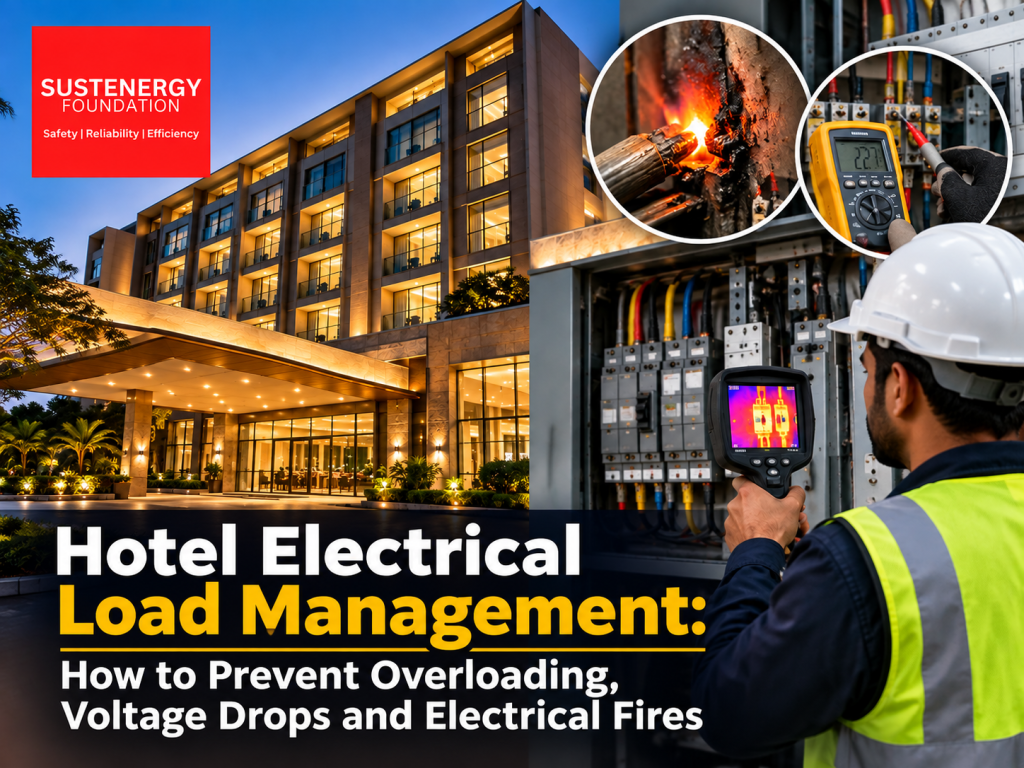
Running a hotel means managing a huge number of electrical loads at the same time. Guest rooms, central air conditioning, kitchens, laundry equipment, elevators, pumps, refrigeration, lighting, banquet halls, IT systems and emergency equipment may all be operating simultaneously.
As occupancy increases, so does the electrical demand.
If the electrical distribution system is not properly monitored and maintained, excessive loading can result in voltage drops, overheating, equipment failures, nuisance tripping and, in serious cases, electrical fires.
This is why hotel electrical load management should be an important part of every hotel’s electrical safety and maintenance programme.
A properly planned Hotel Electrical Safety Audit can help identify overloaded feeders, unbalanced loads, loose connections, thermal hotspots, inadequate protection and other electrical hazards before they develop into costly failures.
What Is Hotel Electrical Load Management?
Hotel electrical load management is the systematic monitoring, assessment and control of electricity consumption across the property.
It is not simply about reducing electricity consumption.
The objective is to ensure that electrical equipment and distribution systems operate safely, efficiently and reliably, even during periods of high occupancy and peak demand.
A typical hotel may have several major electrical loads operating simultaneously, including:
- HVAC and central air-conditioning systems
- Chillers, pumps and cooling towers
- Kitchen equipment
- Laundry machines
- Elevators and escalators
- Guest-room electrical loads
- Lighting and decorative lighting
- Refrigeration systems
- Banquet and conference facilities
- IT and communication systems
- Water heaters
- Fire pumps and other life-safety systems
- EV charging infrastructure
- Emergency power systems
Because these loads have different operating patterns, simply adding equipment nameplate ratings does not provide an accurate picture of the hotel’s actual electrical demand.
A proper hotel electrical load study should consider connected load, demand, diversity, transformer loading, feeder loading and actual operating conditions.
1. Understand the Hotel’s Actual Electrical Load
The first step in effective load management is knowing where and when electricity is being consumed.
Hotels often experience significant changes in electrical demand depending on:
- Occupancy level
- Season
- Time of day
- Banquet events
- Kitchen operations
- Laundry requirements
- HVAC demand
- Outdoor temperature
- EV charging
- Special events and conferences
For example, electrical demand can increase significantly when a hotel is operating at full occupancy while its kitchen, laundry, HVAC and banquet facilities are also running at high capacity.
A professional hotel electrical energy audit and load assessment can help establish the property’s actual demand profile.
Important parameters to monitor include:
- Connected load
- Maximum demand
- Transformer loading
- DG loading
- Main LT panel loading
- SMDB and DB loading
- Feeder currents
- Phase-wise loading
- Power factor
- Voltage variation
- Harmonic distortion
- Neutral current
The objective is to identify the difference between what the system is designed to handle and what the hotel is actually demanding.
2. Prevent Electrical Distribution System Overloading
Electrical overloading is one of the conditions that can lead to excessive heating in cables, busbars, terminals, transformers and switchgear.
The risk becomes greater when electrical connections are loose, equipment is poorly maintained or additional loads are connected without properly assessing the existing system.
During a hotel electrical safety inspection, the following should be evaluated:
- Transformer loading
- Main LT panel loading
- SMDB loading
- MCC/PCC loading
- Individual feeder currents
- Cable size and ampacity
- Cable derating conditions
- Breaker ratings and settings
- Phase load balance
- Neutral loading
- Power factor
- Harmonic levels
- Condition of cable terminations
- Condition of busbar joints
Why Is Phase Balancing Important?
Unequal loading between phases can increase losses and place additional stress on electrical equipment.
A properly balanced electrical distribution system can improve system performance and reduce unnecessary heating.
Hotels should therefore periodically measure phase currents at major distribution boards and investigate significant imbalance rather than waiting for equipment failure.
3. Use Thermal Imaging to Detect Hidden Electrical Problems
Many electrical problems do not produce visible warning signs.
A cable termination may look normal while developing excessive heat. A loose busbar connection may continue operating until the temperature becomes dangerously high.
This is where electrical thermography or thermal imaging becomes extremely valuable.
During a hotel electrical safety audit, thermal imaging can help identify abnormal temperature rises at:
- LT panels
- MCCs
- PCCs
- SMDBs
- Circuit breakers
- Busbar joints
- Cable terminations
- Transformers
- Motor terminals
- Distribution boards
- High-load equipment
Thermal scanning allows maintenance teams to identify potential hotspots before they develop into equipment failures or fire hazards.
Sustenergy Foundation specifically uses thermal imaging as part of its hotel electrical safety services to identify hidden electrical anomalies and potential fire risks.
Important Point
Thermal imaging should not be treated as a replacement for electrical testing.
It works best when combined with:
Visual inspection + electrical measurements + thermal imaging + preventive maintenance.
4. Control Voltage Drops in Hotels
Voltage drop is another electrical problem that can easily be overlooked in large hotels.
A hotel may have long cable runs between the transformer, main LT panel, floor distribution boards and distant equipment.
High current, long cable lengths, undersized conductors and poor electrical connections can contribute to excessive voltage drop.
The consequences may include:
- Motor overheating
- Reduced HVAC performance
- Equipment malfunction
- Increased current
- Nuisance tripping
- Reduced equipment life
- Poor performance of sensitive electronic equipment
Voltage should therefore be checked at both the source and important end-use locations.
Particular attention should be given to:
- HVAC motors
- Chillers
- Pumps
- Kitchen equipment
- Elevators
- Laundry equipment
- Long-distance feeders
- Critical electrical panels
A hotel electrical audit can help determine whether observed voltage problems are associated with the distribution network, excessive loading, conductor sizing or poor connections.
5. Monitor Power Quality, Not Just Energy Consumption
A hotel may monitor its monthly electricity bill without monitoring the quality of the electricity being supplied to its equipment.
However, parameters such as voltage, current, power factor and harmonics can provide valuable information about the health of an electrical system.
Power-quality monitoring can help identify:
- Voltage fluctuations
- Phase imbalance
- Low power factor
- Harmonic distortion
- Excessive neutral current
- Abnormal current demand
- Electrical disturbances
This becomes increasingly important in modern hotels because many facilities contain electronic loads such as:
- Variable Frequency Drives (VFDs)
- UPS systems
- LED lighting
- Electronic controls
- IT equipment
- Inverters
- EV chargers
- Building management systems
Continuous or periodic monitoring can help engineering teams understand how the electrical system behaves under different operating conditions.
6. Don’t Ignore Neutral Loading
Neutral conductors are sometimes overlooked during routine electrical inspections.
However, hotels contain significant numbers of single-phase and electronic loads that can contribute to neutral current and harmonic-related issues.
During a hotel electrical inspection, engineers should evaluate:
- Neutral current
- Phase balance
- Neutral conductor sizing
- Harmonic distortion
- Connections and termination conditions
- Distribution-board loading
Abnormal neutral current should be investigated rather than treated simply as a measurement to be recorded.
7. Electrical Fire Prevention Requires More Than Preventing Overloading
Overloading is only one possible electrical fire risk.
Electrical fires can also result from:
- Loose connections
- Poor cable terminations
- Damaged insulation
- Short circuits
- Improper modifications
- Inadequate protection
- Overheated equipment
- Poor maintenance
- Defective electrical components
- Unauthorised electrical extensions
This is why a comprehensive hotel electrical safety audit should go beyond checking whether breakers are correctly rated.
A practical electrical safety programme can include:
Load monitoring → Visual inspection → Thermal imaging → Insulation testing → Earthing verification → Earth fault loop impedance testing → RCCB/RCD testing → Protection verification → Preventive maintenance → Periodic electrical safety audits
Sustenergy Foundation’s hotel electrical audit services include checks such as earthing effectiveness, earth fault loop impedance, RCCB/RCD testing and thermal imaging.
8. Check Protection Systems and RCCB/RCD Performance
Protective devices are essential for limiting the consequences of electrical faults.
Hotels should periodically verify the condition and operation of:
- MCBs
- MCCBs
- ACBs
- RCCBs
- RCDs
- Overload protection
- Short-circuit protection
- Earth-fault protection
Protection should also be appropriately coordinated so that a fault is cleared by the correct protective device without unnecessarily shutting down a large portion of the hotel.
RCCB/RCD testing is particularly important for circuits where protection against electric shock and earth-leakage-related risks is required.
A professional electrical safety audit should verify the actual operation of these protective devices rather than relying only on visual inspection.
9. Check Earthing and Earth Fault Protection
An effective earthing system is fundamental to hotel electrical safety.
During a hotel electrical safety audit, the earthing system should be assessed through appropriate inspection and testing, including where applicable:
- Earth resistance
- Earth continuity
- Earth fault loop impedance
- Protective conductor continuity
- Equipotential bonding
- Connection integrity
Poor earthing can increase the risk of electric shock and can also affect the operation of protective devices during a fault.
Hotels should therefore treat earthing as an active safety system that requires periodic inspection and testing—not simply as an earth-pit resistance value recorded once a year.
10. Include Emergency Power Systems in Load Management
Hotels depend heavily on emergency and backup power systems.
Generators, ATS systems, UPS systems and emergency distribution boards must be capable of supporting the loads assigned to them.
During an electrical safety audit, engineering teams should review:
- DG loading
- DG load distribution
- Generator changeover
- ATS operation
- UPS loading
- Battery backup
- Emergency lighting
- Fire pumps
- Critical communication systems
- Emergency distribution boards
The objective is to ensure that emergency power is available where it is actually required when the normal supply fails.
11. Pay Special Attention to Kitchens and Laundry Areas
Commercial kitchens and laundry facilities are among the high-load areas in many hotels.
They may contain ovens, cooking equipment, dishwashers, washing machines, dryers, steam equipment, exhaust systems, refrigerators and other high-power appliances.
These areas should receive particular attention during a hotel electrical safety inspection.
Checks should include:
- Equipment earthing
- Dedicated circuits
- Cable condition
- Plug and socket condition
- Protection-device operation
- Load current
- Cable termination
- Thermal hotspots
- Water and moisture exposure
- Unauthorized electrical modifications
A small electrical problem in a high-load area can quickly become a major operational or fire-safety issue.
12. Monitor New Loads Such as EV Charging
The electrical demand profile of hotels is changing.
EV charging stations are increasingly being installed at hotels, resorts and commercial properties.
Adding EV chargers without reviewing the existing electrical infrastructure can increase peak demand and potentially overload transformers, panels or feeders.
Before adding significant new loads, hotel management should consider:
- Available transformer capacity
- Existing maximum demand
- Feeder capacity
- Panel capacity
- Cable sizing
- Protection coordination
- Power quality
- Load-management strategy
- Future expansion requirements
A new electrical load should be assessed as part of the overall hotel electrical load management system, rather than treated as an isolated installation.
13. Move from Reactive Maintenance to Predictive Electrical Management
Traditional maintenance often follows a simple pattern:
Something fails → breaker trips → maintenance team responds.
Modern hotel engineering teams can move toward a more proactive approach.
Smart meters, power-quality analysers, energy-monitoring systems and Building Management System (BMS) integration can provide continuous information about electrical performance.
Hotels can monitor trends such as:
- Maximum demand
- Voltage
- Current
- Power factor
- Harmonics
- Transformer loading
- Panel loading
- Energy consumption
- Equipment temperature
When these parameters are tracked over time, unusual changes can be detected before they develop into major problems.
This is where remote energy monitoring and hotel energy management can complement an electrical safety programme. Sustenergy Foundation also provides energy monitoring and energy-saving services for hotels and resorts.
14. Conduct a Periodic Hotel Electrical Safety Audit
The most effective way to bring all these activities together is through a structured Hotel Electrical Safety Audit.
A comprehensive audit can examine:
Electrical Distribution
- Transformers
- LT panels
- SMDBs
- MCCs
- PCCs
- Distribution boards
- Feeders
- Cables
Electrical Protection
- MCBs
- MCCBs
- ACBs
- RCCBs/RCDs
- Protection settings
- Earth-fault protection
Testing
- Earth resistance
- Earth fault loop impedance
- Insulation resistance
- RCD/RCCB testing
- Voltage and current measurements
- Power-quality measurements
Thermal Inspection
- Panels
- Busbars
- Breakers
- Cable terminations
- Transformers
- Motors
Safety Systems
- Earthing
- Lightning protection
- Equipotential bonding
- Emergency power
- Fire pumps
Operational Areas
- Guest rooms
- Kitchens
- Laundry
- Banquet halls
- Plant rooms
- Electrical rooms
- Common areas
- Outdoor installations
The findings can then be classified according to risk and converted into a practical corrective-action plan.
15. Don’t Wait for an Electrical Failure to Tell You There Is a Problem
Electrical systems rarely fail without warning.
A rising temperature at a cable termination, increasing feeder current, declining insulation resistance, abnormal voltage or repeated breaker tripping may all be early indicators of a developing problem.
The goal of a professional hotel electrical safety audit is to identify these warning signs while there is still time to correct them.
For hotel owners and engineering teams, this means fewer unexpected failures, better electrical reliability, improved safety and potentially lower maintenance costs.
Conclusion: Safe Load Management Is Essential for Hotel Reliability
Hotel electrical load management is about much more than reducing the electricity bill.
It is about making sure that the electrical infrastructure can safely support the hotel’s operations today while remaining capable of handling future loads.
Accurate load assessment, balanced distribution, proper cable sizing, voltage-drop control, power-quality monitoring, coordinated protection, effective earthing, thermal imaging and preventive maintenance all contribute to a safer hotel electrical system.
A periodic Hotel Electrical Safety Audit and Load Management Assessment can help identify overloaded feeders, voltage-drop problems, thermal hotspots, poor connections, protection issues and emerging electrical fire risks before they result in guest disruption, equipment damage or a serious incident.
At Sustenergy Foundation, our hotel electrical safety and energy audit services are designed to help hotels and resorts improve electrical safety, reliability, compliance and energy performance through practical testing, inspection and engineering recommendations. The organisation currently positions its hospitality services around electrical safety audits, energy audits, thermal imaging, earthing effectiveness, RCCB/RCD testing, lightning protection and energy optimisation.
Don’t wait for an electrical failure. Identify the risk before it becomes an incident.
Frequently Asked Questions
Why is electrical load management important in hotels?
Hotels operate multiple high-power systems simultaneously. Proper load management helps prevent excessive loading, overheating, voltage problems, equipment failures and unnecessary power interruptions.
How often should a hotel conduct an electrical safety audit?
Audit frequency should be based on the property’s risk profile, age, electrical complexity and operating conditions. High-occupancy and critical areas may require more frequent inspections, while a comprehensive electrical safety audit should be supplemented by targeted inspections and preventive maintenance. Sustenergy Foundation recommends annual professional electrical safety audits for hotels as part of a proactive safety programme.
What is included in a hotel electrical safety audit?
Depending on the scope, an audit can include electrical distribution inspection, earthing and earth-fault loop impedance testing, RCCB/RCD testing, insulation testing, thermal imaging, protection-system checks, room inspections, kitchen and laundry inspections, emergency power-system checks and compliance assessment.
Can thermal imaging prevent electrical fires in hotels?
Thermal imaging can identify abnormal heating at electrical connections and equipment before a visible failure occurs. It is an important predictive-maintenance tool, but it should be combined with proper electrical testing, inspection and corrective maintenance.
Can electrical load management reduce hotel energy costs?
Yes. Understanding where and when electricity is being consumed can help engineering teams identify inefficient equipment, excessive demand, poor power factor and other energy-saving opportunities. Load management is therefore closely connected with hotel energy management and energy audits.
Why should hotels conduct an electrical safety audit before opening?
A pre-opening electrical inspection can identify safety, reliability and installation issues before guests occupy the property. Sustenergy Foundation provides specialised pre-opening electrical inspection services covering areas such as earthing, electrical protection, RCCB testing, earth-fault loop impedance and thermal imaging.
