
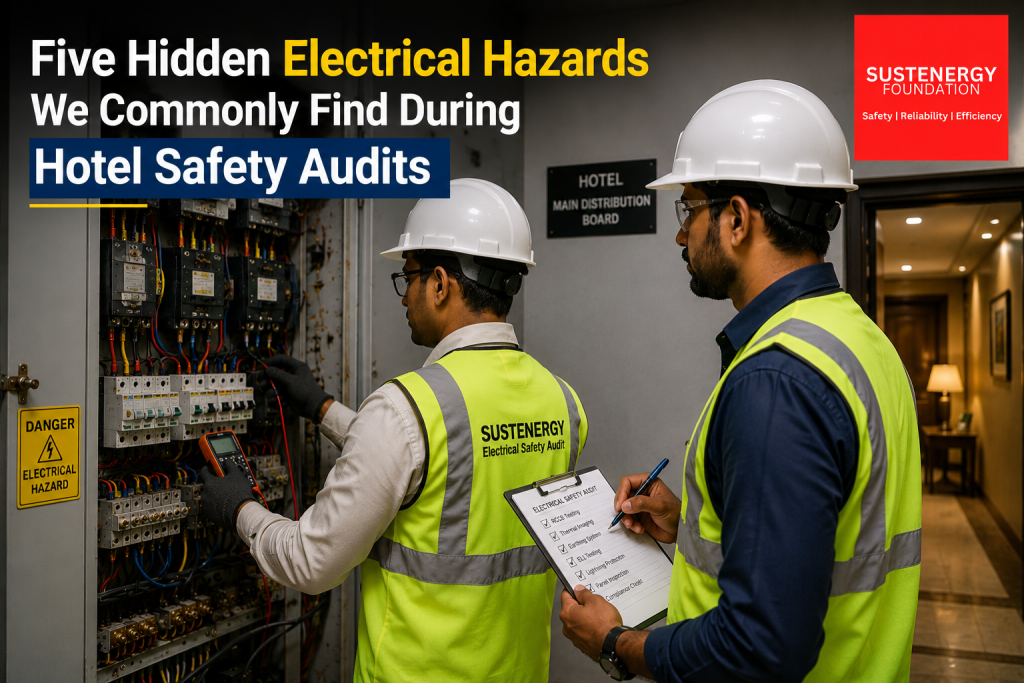
Hotels work hard to create memorable guest experiences. From luxurious interiors and excellent hospitality to robust security and hygiene practices, every detail matters. However, one critical aspect often remains hidden in the background until something goes wrong—electrical safety.
Unlike visible maintenance issues, electrical hazards are usually concealed inside switchboards, electrical panels, ceilings, walls, or service areas. They may not show any obvious warning signs until they lead to an electrical fire, equipment breakdown, unexpected power outage, or even a life-threatening accident.
At Sustenergy Foundation, our team has conducted hotel electrical safety audits across luxury hotels, business hotels, resorts, and hospitality facilities throughout India. One thing is consistent across properties of every size—many serious electrical hazards remain undetected during routine maintenance.
The good news is that these risks are highly preventable through a professional hotel electrical safety audit, regular inspections, predictive maintenance, and compliance with electrical safety standards.
Here are five of the most common electrical hazards we encounter during hotel electrical safety inspections—and how your hotel can prevent them.
1. Missing or Bypassed RCCBs – A Hidden Risk That Can Cost Lives
Residual Current Circuit Breakers (RCCBs) are among the most important life-saving electrical protection devices installed in a hotel. Their job is simple—they disconnect the power supply immediately whenever they detect dangerous earth leakage currents.
Unfortunately, during many electrical safety audits for hotels, we find RCCBs that are:
- Not installed on critical circuits
- Faulty or damaged
- Incorrectly rated
- Intentionally bypassed after repeated nuisance tripping
Although bypassing an RCCB may appear to solve an operational issue, it removes one of the most important safeguards against electric shock.
Imagine a faulty water heater in a guest room, an insulation failure inside laundry equipment, or leakage from kitchen appliances. Without a functioning RCCB, staff and guests may unknowingly come into contact with dangerous touch voltages.
How to Prevent It
- Install RCCBs as per applicable IS/IEC electrical standards.
- Never bypass an RCCB simply because it trips repeatedly.
- Identify and rectify the actual fault causing the trip.
- Test RCCBs periodically using calibrated test instruments.
- Replace defective or improperly rated devices immediately.
- Maintain documented testing records as part of preventive maintenance.
A properly functioning RCCB disconnects the supply within milliseconds, making it one of the simplest and most effective ways to prevent serious electrical accidents.
2. Overheating Electrical Panels – The Fire Risk You Can’t See
One of the biggest advantages of a hotel electrical safety audit is the use of thermal imaging to identify hidden overheating inside electrical installations.
During thermographic inspections, we frequently discover hotspots in:
- Main LT panels
- Distribution boards
- MCCBs and breakers
- Busbars
- Cable terminations
- Neutral connections
- Capacitor banks
These hotspots usually develop because of:
- Loose electrical connections
- Overloaded circuits
- Corroded terminals
- Unbalanced electrical loads
- Aging electrical components
Since overheating occurs inside enclosed panels, maintenance teams often don’t notice the problem until insulation starts burning or equipment fails unexpectedly.
By then, the damage may already be severe.
How to Prevent It
- Conduct annual thermal imaging inspections.
- Tighten electrical connections using manufacturer-recommended torque values.
- Balance loads across all three phases.
- Replace damaged breakers, connectors, and worn electrical components.
- Investigate any abnormal temperature rise immediately instead of waiting for failure.
Predictive maintenance using thermal imaging significantly reduces the chances of electrical fires and unplanned power interruptions.
3. Poor Earthing and High Earth Fault Loop Impedance
An effective earthing system is the foundation of every safe electrical installation.
However, during hotel electrical inspections, we regularly find issues such as:
- Damaged earth conductors
- Corroded earthing connections
- Broken protective earth continuity
- Improper bonding
- Excessively high Earth Fault Loop Impedance (EFLI)
Many hotels focus only on earth resistance testing, but this alone does not confirm whether protective devices will disconnect quickly during an electrical fault.
If the Earth Fault Loop Impedance is too high, breakers may not operate within the required disconnection time. This means exposed metal parts can remain energized longer, increasing the risk of electric shock and equipment damage.
How to Prevent It
- Measure earth resistance periodically.
- Perform Earth Fault Loop Impedance (EFLI) testing throughout the property.
- Verify protective earth continuity.
- Repair damaged earth conductors without delay.
- Maintain proper equipotential bonding across the facility.
A comprehensive electrical safety audit for hotels always includes both earthing verification and EFLI testing to ensure the entire protection system functions correctly during fault conditions.
4. Inadequate Lightning Protection Systems
Hotels often have tall buildings, rooftop HVAC units, communication antennas, solar power systems, and decorative structures that make them vulnerable to lightning strikes.
During audits, we frequently identify problems such as:
- Missing air terminals
- Damaged down conductors
- Corroded lightning protection components
- Improper bonding
- Failed or missing Surge Protection Devices (SPDs)
- Lack of periodic inspection and testing
A single lightning strike can disrupt:
- Elevators
- Fire alarm systems
- Building Management Systems (BMS)
- Networking equipment
- CCTV systems
- Guest room electronics
- Hotel operations
The financial impact of such failures can be substantial, especially during peak occupancy.
How to Prevent It
- Inspect the complete lightning protection system regularly.
- Test continuity of all down conductors.
- Verify earth termination resistance.
- Ensure Surge Protection Devices are installed correctly and replaced when required.
- Reassess the lightning protection system whenever rooftop equipment is modified or expanded.
A well-maintained lightning protection system protects both lives and business continuity.
5. Electrical Panels Hidden Behind Decorative Materials
Modern hotel interiors often prioritize aesthetics, but sometimes this creates unexpected electrical hazards.
One issue we increasingly encounter during hotel electrical safety audits is electrical panels concealed behind:
- Wooden decorative panels
- Laminates
- Furniture
- Curtains
- Storage units
- Other combustible materials
While these installations may improve appearance, they create serious safety concerns.
Hidden electrical panels can:
- Delay emergency isolation during faults
- Restrict ventilation and increase overheating
- Increase the surrounding fire load
- Make routine inspection difficult
- Obstruct maintenance personnel during emergencies
In the event of an electrical fault, nearby combustible materials can accelerate fire growth and make firefighting far more difficult.
How to Prevent It
- Maintain adequate working clearance around all electrical panels.
- Never store combustible materials near energized electrical equipment.
- Clearly label all distribution boards and switchboards.
- Ensure electrical panels remain easily accessible at all times.
- Include electrical safety considerations during interior renovations and design modifications.
Good interior design should always complement—not compromise—electrical safety.
Why Every Hotel Needs a Professional Electrical Safety Audit
Electrical failures rarely occur without warning. In most cases, the warning signs exist long before an incident—but they remain unnoticed without proper inspection.
A professional hotel electrical safety audit helps identify hidden risks before they develop into:
- Electrical fires
- Power failures
- Equipment damage
- Guest complaints
- Business interruptions
- Safety incidents
- Regulatory non-compliance
A comprehensive audit typically includes:
- RCCB testing
- Thermal imaging (Thermography)
- Earth resistance testing
- Earth Fault Loop Impedance (EFLI) testing
- Lightning protection system assessment
- Electrical panel inspection
- Distribution board inspection
- Protective device verification
- Electrical installation compliance checks
These inspections help hotels improve reliability, enhance guest safety, reduce maintenance costs, and protect valuable assets.
Final Thoughts
Electrical safety should never be viewed as just another compliance requirement. It is an essential investment in protecting your guests, employees, reputation, and business operations.
Many of the electrical hazards found in hotels remain hidden until they result in a costly breakdown or a devastating fire. Fortunately, most of these risks can be identified and corrected through regular inspections, hotel electrical safety audits, and predictive maintenance practices like thermal imaging.
Whether you manage a luxury resort, business hotel, boutique property, or hospitality chain, taking a proactive approach to electrical safety today can prevent major incidents tomorrow.
A safe electrical system doesn’t just keep the lights on—it keeps your hotel running, your guests protected, and your reputation intact.
