
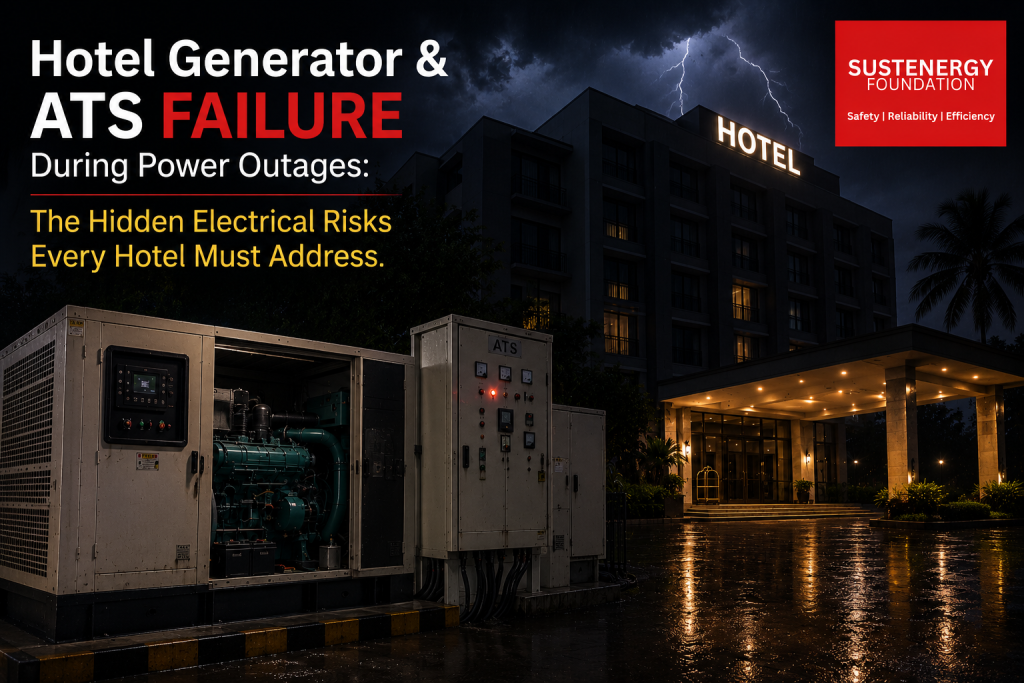
Power failures are unpredictable—but your hotel’s response to them shouldn’t be.
Whether caused by storms, grid failures, or maintenance issues, a power outage can disrupt hotel operations within seconds. Guests expect elevators to work, emergency lights to illuminate escape routes, fire protection systems to remain operational, and essential services to continue without interruption.
This is why every hotel invests in standby diesel generators and Automatic Transfer Switches (ATS). However, one common misconception exists across the hospitality industry:
If the generator starts during monthly testing, everything is fine.
Unfortunately, that isn’t always true.
Many hotels discover hidden faults in their emergency power systems only during an actual outage—when there is no second chance. A professionally conducted Hotel Electrical SafetyAudit helps identify these issues before they become costly emergencies.
Why Emergency Power Is Critical for Hotels
Modern hotels rely on electricity for almost every guest service. During a utility power failure, emergency power systems must immediately take over to keep critical operations running safely.
These systems support:
- Emergency lighting in corridors, staircases, and exit routes
- Fire alarm and fire detection systems
- Fire pumps and sprinkler systems
- Guest elevators operating in emergency mode
- CCTV surveillance and security systems
- Access control systems
- IT infrastructure and communication equipment
- Kitchen refrigeration and cold storage
- Critical HVAC systems
- Emergency public announcement systems
A delay of even a few seconds can create confusion, panic, and operational disruption. In larger hotels, the consequences may include evacuation challenges, guest complaints, financial losses, and damage to the hotel’s reputation.
Hidden Problems That Often Go Unnoticed
Generators typically remain idle for weeks or months until they are needed. During this period, several hidden defects can develop without any visible warning signs.
During a Hospitality Electrical Safety Audit, engineers frequently identify issues such as:
- ATS failing to transfer power automatically
- Generator start-up delays
- Weak or discharged starting batteries
- Battery charger failures
- Low or contaminated diesel fuel
- Cooling system problems
- Loose electrical connections
- Corroded terminals
- Overloaded emergency distribution panels
- Improper earthing and bonding
- Faulty protective relays
- Generator synchronization issues in multi-generator installations
In many cases, the generator starts successfully but cannot carry the building’s full emergency load because of poor maintenance or incorrect load management.
These failures usually remain hidden until the exact moment emergency power is required.
The Automatic Transfer Switch (ATS): The Unsung Hero
The Automatic Transfer Switch (ATS) is often the most overlooked component of the emergency power system.
Its job is simple but critical—it detects utility power failure, starts the generator, transfers the electrical load, and safely switches back when grid power returns.
If the ATS malfunctions, the generator may run perfectly while the hotel still remains without electricity.
Common ATS issues identified during Electrical Safety Audits for Hotels include:
- Burnt contacts
- Worn contactors
- Mechanical interlock failures
- Incorrect timer settings
- Relay failures
- Control circuit faults
- Loose cable terminations
- Improper cable sizing
- Lack of preventive maintenance
Routine inspection and operational testing of ATS panels are essential to ensure reliable performance during emergencies.
Emergency Lighting: A Small System with a Big Responsibility
When the lights go out, emergency lighting becomes one of the most important life safety systems in a hotel.
Guests who are unfamiliar with the building depend entirely on illuminated escape routes to evacuate safely.
Yet, emergency lighting systems are among the most neglected electrical assets.
Electrical safety audits commonly reveal:
- Emergency lights that no longer operate
- UPS batteries reaching the end of their service life
- Exit signs that fail to illuminate
- Emergency lighting connected to the normal power supply instead of backup power
- Faulty battery chargers
- Reduced battery backup duration
- Damaged or poorly maintained emergency light fittings
Even a short power interruption can leave staircases and corridors completely dark if these systems are not maintained properly.
International best practices recommend routine functional testing along with periodic full-duration battery discharge tests to verify actual backup performance.
Why Routine Generator Testing Isn’t Enough
Many hotels conduct monthly “generator start tests.” While these tests confirm that the engine starts, they rarely verify the complete emergency power system.
A generator test alone cannot confirm whether:
- The ATS transfers power correctly
- Emergency lighting functions properly
- UPS systems perform as expected
- Emergency distribution panels can handle the load
- Protective devices operate correctly
- Critical services receive uninterrupted power
A comprehensive Hotel Electrical Safety Audit evaluates the entire emergency electrical infrastructure—not just the generator itself.
What Does a Hotel Electrical Safety Audit Include?
Unlike routine maintenance, a Hotel Electrical Safety Audit provides a complete assessment of the safety, reliability, and performance of the hotel’s electrical infrastructure.
A professional audit generally includes:
- Generator performance assessment
- ATS operational testing
- Emergency load transfer verification
- Emergency power distribution inspection
- UPS performance evaluation
- Emergency lighting system testing
- Battery bank inspection
- Thermal imaging of electrical panels
- Earthing and bonding measurements
- Earth Fault Loop Impedance (EFLI) testing
- RCCB/RCD performance testing
- Power quality analysis
- Electrical load assessment
- Protective relay verification
- Compliance review with applicable electrical standards
These inspections help identify ageing equipment, hidden defects, and maintenance gaps before failures occur.
Benefits of Periodic Hotel Electrical Safety Audits
Hotels that conduct periodic Electrical Safety Audits enjoy significant long-term benefits:
- Improved guest and employee safety
- Reliable emergency power during outages
- Reduced electrical failures and downtime
- Lower maintenance costs through predictive maintenance
- Better compliance with statutory and hotel brand requirements
- Enhanced business continuity
- Improved insurance risk profile
- Greater resilience during storms and grid failures
More importantly, these audits help prevent electrical emergencies instead of simply responding to them.
Prevention Costs Less Than Failure
The cost of a generator or ATS failure goes far beyond equipment repairs.
Unexpected power failures can result in:
- Guest dissatisfaction
- Revenue loss from cancelled events
- Food spoilage
- Operational downtime
- Reputation damage
- Increased insurance claims
- Potential legal liabilities if safety systems fail
Compared to these risks, investing in a periodic Hotel Electrical Safety Audit is a practical and cost-effective preventive measure.
Final Thoughts
A generator is only one part of a much larger emergency power system.
Its effectiveness depends on the health of the ATS, UPS, emergency lighting, electrical distribution network, protective devices, and maintenance practices. Hidden electrical defects often remain unnoticed until an actual emergency exposes them.
A professionally conducted Hotel Electrical Safety Audit helps hotels identify these risks early, improve system reliability, and ensure emergency power systems perform exactly as intended when every second matters.
For hotels that prioritize guest safety, operational continuity, and regulatory compliance, periodic Electrical Safety Audits for Hotels should be an essential part of facility management—not just a compliance exercise, but a strategic investment in safety and business resilience.
